Current Residents Resources
Menu
- Welcome Guide
- Using the Tenant Web Access Portal
- Download the rmResident App
- Making Payments
- Moving In
- Utilities – Guidelines & FAQs
- FAQs- Rent/Fees
- The Dos and Don’ts of Personalizing Your Rental Property
- Maintenance Issues to Avoid – Save Your Security Deposit!
- Submitting a Maintenance Request – What You Need to Know
- Tips & Tricks for Matchbox Tenants – “How Tos”
- Local Transit Schedule
- Changing Lease Terms
- Planning for Next Year’s Housing
- Moving Out & Security Deposits
Menu
Utilities – Guidelines & FAQs
Utilities for Matchbox properties vary by property and may include, but are not limited to, electricity, water/sewer, trash removal, lawn/landscaping, snow removal, natural gas, oil, and/or propane. Tenant(s) are responsible for knowing their obligations – who pays for which utilities – as specified per the Lease. Please check to establish the steps necessary for setting up Utilities at your residence PRIOR to your Lease Start Date. Utilities that are Tenant(s) responsibility must be kept on and in your name(s) for the duration of your lease term (Lease Start to Lease End Date). If you have any questions concerning the utilities for a specific property, please email info@matchboxrealty.com or call 540 434–5150.
Please see our FAQs below for additional information on utilities.
How do I turn on utilities?
The Tenant(s) is responsible for placing all utilities in their name and paying all utility bills due for services to the premises for which the Tenant is responsible (unless otherwise agreed to in the lease). In order to establish what utilities you are responsible for, please review your lease and check the property page on our website.
On the website, you will find a Utilities tab under Property Details that lists the contact information for each utility. If you have any questions regarding utilities, please reach out to your Property Manager.
If you are a JMU student, we recommend contacting JMU’s Utility Deposit Assistance Program PRIOR to contacting utility companies.
Most utility providers will only put an account in one person’s name. Please work this out with your roommates.
What is JMU’s Utility Deposit Assistance Program?
UDAP is a JMU sponsored program in partnership with utility companies to allow students utility connection WITHOUT paying the varying deposit amounts of $350 for water/sewer, $200 for gas, or up to $350 for electric. This can only be purchased between April and July of your move in year. Only one tenant per unit needs to purchase the contract.
With the purchase of a UDAP contract, deposit fees for connecting water, gas, and electricity are reduced/eliminated. The amount limits are as follows:
-
- Gas: Up to $500
- Electric: Up to $350 with Harrisonburg Electric Commission; Up to $600 with Shenandoah Valley Electric Cooperative
- Water: Up to $350
To be eligible to purchase a UDAP contract:
- You must be enrolled as a full-time, degree-seeking, currently active JMU student.
- You must have no financial holds on your JMU account.
- You must be a student living off campus.
- You must have a JMU Email.
How long is the JMU UDAP Contract? When do I renew?
UDAP (Utility Deposit Assistance Program) contracts expire each year on July 31, 20XX. Upon expiration, UTILITIES WILL BE DISCONNECTED. You must renew your contract each year prior to this date in order to avoid a lapse in your utilities. UDAP expiring on July 31 does not result in your account being closed and you should renew rather than opening another account. However, you will be subject to an interruption of services if you do not renew on time.
Steps to take to renew:
- Contact JMU to renew your UDAP contract or to verify qualification; you may renew online at https://login.jmu.edu
- Once renewed, call or email the utilities companies with your new UDAP contract number and address.
- If you are a senior and/or no longer qualify for a UDAP contract with JMU and require utility services after July 31, 20XX please contact the appropriate departments to place a deposit to continue services.
UDAP has no authority to connect or disconnect your utilities. When you move out, be sure to call your utility companies and disconnect services in your name.
For questions or concerns please contact the Utilities Deposit Assistance Program:
MSC 4214
285 Warren Service Drive
Room 205 H-L
Harrisonburg, Virginia 22807
When do I need to turn on my utilities? Can I turn off my utilities if I move out early?
Per your lease, you are required to have your utilities on from the lease start date through the lease end date. Keeping utilities active is essential for the safe operation and maintenance of the property. Utility disconnections can impair important building systems, delay emergency response efforts, and prevent necessary maintenance and inspections from being performed. Disconnection could also cause appliance failure and/or damages. In this case, you could be responsible for the replacement of those appliances.
If you fail to turn on your utilities by your move-in date and/or during your lease term you shutoff utilities, the services can/will be transferred to Matchbox’s name. Our office will receive a bill; upon processing – you and your roommates will each receive a Utility Bill Payment Fee for each bill we receive (per your Lease), in addition to the cost of utility usage. You may also be subjected to charges associated with the reconnection of the utilities by the providers and the Utility Bill Payment Fee(s). To avoid the possibility of a fine, please ensure you have water, electric, natural gas, and oil services (where applicable) ON and in your name(s) for the duration of your lease term. This includes Winter Break, Summer Break and extended vacations.
Even if you move out early, you may not turn off your utilities prior to the lease end date. Before disconnecting utility service, residents should confirm whether a current roommate will continue living in the property and, if so, arrange a transfer of service through the utility provider. If all current residents are moving out, incoming residents will be responsible for establishing utility service in their own names before move-in.
Can I turn off my heat during winter break to save money?
During periods of cold weather, residents should maintain a temperature sufficient to protect the property and its plumbing systems from freezing. Heat should not be turned off completely, even when the apartment is unoccupied. Failure to maintain adequate heat may result in frozen pipes, water damage, and other property damage for which residents may be held responsible.
To help reduce energy consumption while protecting the property, residents may lower the thermostat to no less than 55°F when away, keep blinds and curtains closed to improve energy efficiency, and open cabinet doors beneath sinks and around plumbing fixtures to allow warm air to circulate around pipes.
My water bill was high. What do I do?
The number one reason a water bill is very high is due to a toilet running frequently or constantly. A running toilet can consume 25,000 gallons or more a month. See maintenance troubleshooting guidance for high water usage. If you can identify the problem, such as a toilet or leaking sink, reach out to us explaining the issue so that we can help facilitate getting this repaired. If you are unsure where the excessive water bill is coming from, please turn in a work order so that it can be investigated.
For information on water usage, see the following infographic.
My power bill was high. What do I do?
For how energy gets used and wasted, see the following infographic.
Dumpster Service Guidelines
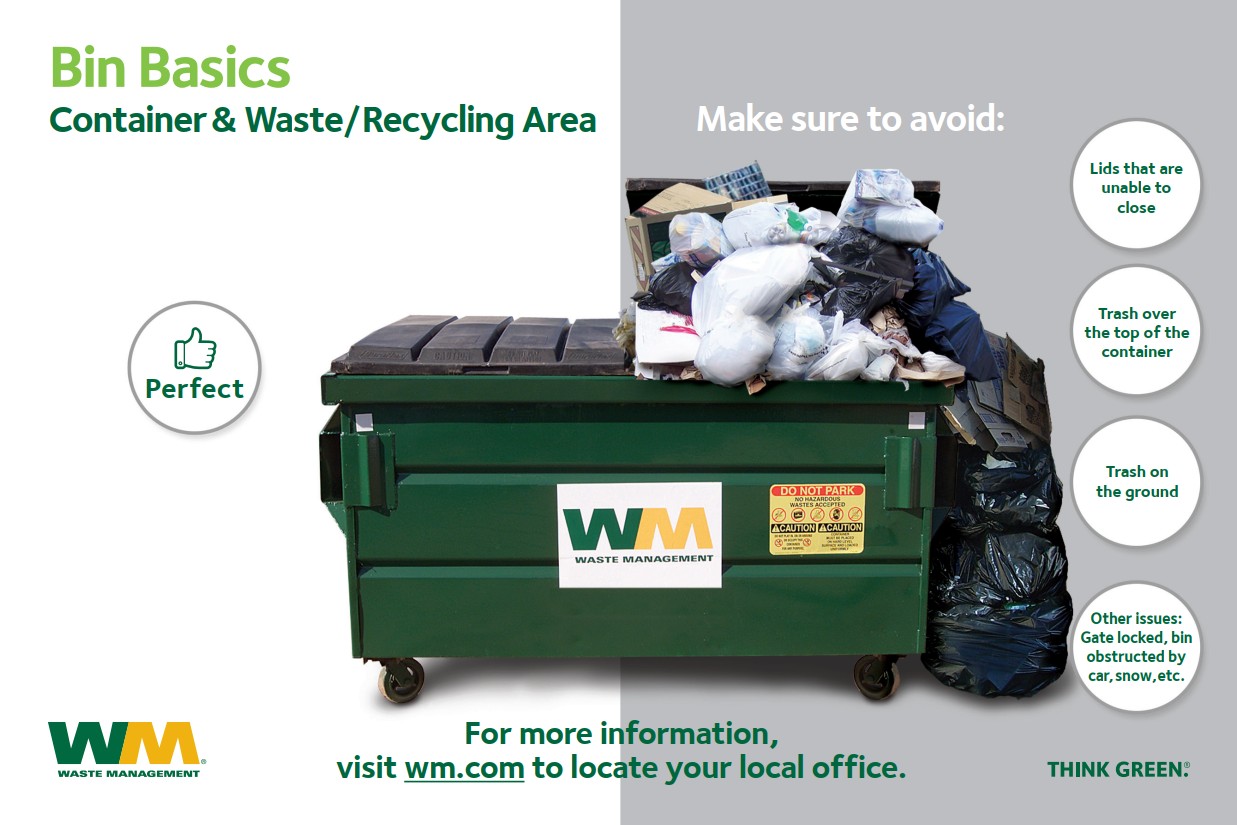
Some properties are serviced by dumpster trash collection. While waste collection providers may vary by property, the following best practices apply universally and are essential to timely pickup:
• Trash collection is performed mechanically; drivers do not exit the vehicle during pickup.
• Drivers do not handle loose or bulk items, including appliances, mattresses, or furniture.
• Do not place trash on top of dumpsters.
• Do not leave trash on the ground or around the dumpster area.
• Do not place large items near the dumpster, as they will not be collected.
• Ensure dumpster lids can fully close.
• Keep dumpster areas accessible—do not block with vehicles.
• Keep access points clear of snow, debris, or other obstacles.
If the dumpster is overfilled or obstructed, the driver will decline collection. If you have excess trash, please hold it in a secure indoor location until the next scheduled pickup.
If a driver is unable to access or service the dumpster, the collection may still be billed even if pickup does not occur. Following these guidelines helps prevent service disruptions and unnecessary costs.
For safety reasons, never climb on or into a dumpster.
Utility Provider Resources
Please note that utility providers will vary between properties. Contact your Property Manager to confirm your provider. Please find a list of providers below or see our Utilities page.
ELECTRICITY
Harrisonburg Electric Commission
Website: HarrisonburgElectric.com
Telephone: (540) 434-5361
Dominion Power
Website: DOM.com
Telephone: (866) 366-4357
Shenandoah Valley Electric Cooperative
Website: SVEC.coop
Telephone: (540) 434-2200
WATER & SEWER
Harrisonburg Water & Sewer
Website: HarrisonburgVA.gov/water
Telephone: (540) 434-9959
Rockingham Co. Public Works
Website: RockinghamCountyVA.gov
Telephone: (540) 564-3020
Staunton Public Works
Website: Staunton.va.us
Telephone: (540) 332-3892
Utility Billing Service
Website: WaterSystems.com
Telephone: (800) 366-0206
NATURAL GAS
Columbia Gas
Website: ColumbiaGasVA.com
Telephone: (800) 543-8911
TV & INTERNET
Comcast
Website: Comcast.com
Telephone: (888) 266-2278
Telephone: (855) 638-2855
Glo Fiber
Website: Glofiber.com
Telephone: (877) 492-6845
Verizon
Website: Verizon.com
Telephone: (800) 483-4000
TRASH & RECYCLING
Harrisonburg Public Works Dept.
Website: HarrisonburgVA.gov/Trash
Telephone: (540) 434-5928
OIL
CL Cluster
Website: CLCuster.com
Telephone: (540) 434-8888
Rockingham Petroleum
Website: RockinghamPetroleum.com
Telephone: (540) 434-4321
Quarles Petroleum Inc
Website: QuarlesInc.com
Telephone: (540) 434-3434
TOW SERVICE
First Choice Towing
Address: 20 W Washington St. | Harrisonburg, Va 22802
Telephone: (540) 478-4869
How are utility charges billed when utilities are provided by the landlord?
At some properties, the property owner receives a single bill from the utility provider and residents are billed separately based on the utility usage recorded for their unit. Depending on the property, this may include water, gas, hot water, electricity, or other metered utilities.
How is my water bill calculated if water is provided by the landlord?
At some properties, water service is paid by the property owner and then billed back to residents based on their individual usage.
Each billing period, water meter readings are collected for each unit and the amount of water used is calculated. Residents are then charged based on the measured consumption, along with any applicable minimum or processing charges.
Because the utility provider bills the property, rather than each apartment individually, utility billing rates may occasionally be adjusted to ensure the total cost of providing water service is accurately recovered. This includes:
- Charges billed by the utility provider
- Utility minimum service charges
- Meter reading and billing administration costs
Why is there a charge even when little or no water is used?
The City of Harrisonburg assesses a minimum charge even when no water is consumed. During periods of reduced occupancy or lower overall usage, these fixed costs remain in place.
To ensure the property’s utility expenses are covered fairly, minimum billing amounts or per-gallon usage rates may be adjusted when necessary. If overall usage later returns to normal levels, billing rates may be adjusted accordingly.
When are water bills issued?
Water meters are typically read monthly. Charges are calculated using the most recent meter readings and are then posted to the resident’s account.
What if I have questions about my utilities that are provided by the landlord?
If you have questions about your usage, billing calculations, or a specific charge on your account, please contact our office or your Property Manager directly.
If you have questions about a bill received from a utility provider, please contact that provider directly.
